


Unlock more with the Adobe Firefly Pro plan with access to Adobe Podcast Premium 
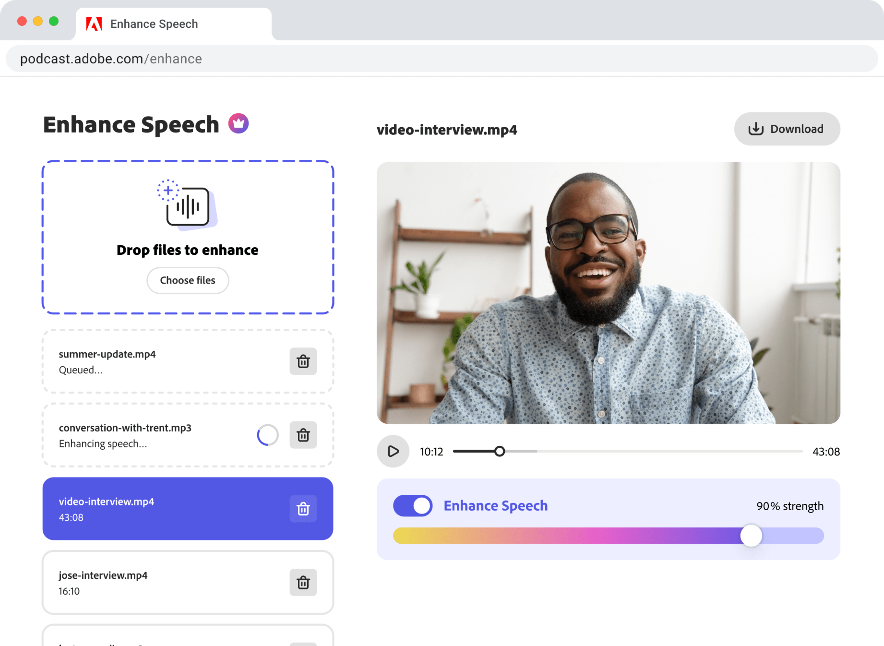
- Enhance Speech fixes audio problems after the fact, no perfect mic needed
- Video support for MP4, MOV, and more
- Bulk upload files for enhancement
- Adjust speech, music, and ambience for a more natural sound
- Enhance up to 4 hours a day, files up to 1 GB
- No download limits on Studio projects
- Download original recordings, speaker-separated
- Customize audiograms and captions with themes
- Upload custom backgrounds for audiograms
- 4,000 generative credits/month and unlimited generation on select image models
Enhance Speech


Studio


Create with Firefly Pro

 Start free trial
Importing your multitrack StreamYard recordings into Adobe Podcast
From live-streamed conversations to finished episodes—how to import and shape your StreamYard recordings.
Last updated: February 18, 2026
Author: Harmony Jiroudek, Product education & community manager
Some creators like to keep things simple by recording and streaming from the same place—no extra tabs, no complicated setup. If that sounds familiar, StreamYard might already be part of your workflow. It’s easy for guests to join, the interface is friendly, and it doubles as a way to livestream your show while also capturing a clean recording.
StreamYard allows you to download individual participant recordings (when local recordings are enabled). Using separate tracks gives you more flexibility inside Adobe Podcast — especially when adjusting levels, reducing background noise, or cleaning up overlapping speech.
Before we jump into editing, let’s make sure you know how to download these files from StreamYard.
1. Download your individual tracks from StreamYard
To prepare your files for Adobe Podcast:
1. Sign in to StreamYard
2. Click on Library in the left-hand navigation.
3. Select the recording you want to edit.
4. Download the individual participant tracks (local recordings).
If available, you may also download the mixed program file as a reference — but for editing in Adobe Podcast, you’ll want the separate participant files.
Note: Separate tracks must be enabled before recording in StreamYard. If you only see a single mixed file, multitrack editing will not be available.
2. Organize your files
Before uploading, take a moment to prepare your files:
- Keep one file per participant.
- Rename each file clearly (for example: host.wav, guest-ana.wav).
Clear file names help you quickly identify speakers once your tracks are imported.
3. Uploading your StreamYard tracks into Adobe Podcast
Once you’ve got your individual StreamYard files labeled and organized, it’s time to bring them into Adobe Podcast for editing. Adobe Podcast makes the upload process really simple, and because you’re working with multitrack audio, it opens up a lot of flexibility for polishing up your recording.
Step-by-step: Importing your files
1. Head to Adobe Podcast at podcast.adobe.com
- Log in with your Adobe ID — or create one if you haven’t already (there’s a free version!)
2. Navigate to Studio, https://podcast.adobe.com/studio, and click “New Project”
- You’ll be taken to a blank project where you can start uploading files.
3. Drag and drop your multitrack audio files
- Click on the “Add” icon to the left, and select “Upload a group recording”
- Just grab your renamed StreamYard files (like Host_Jordan.m4a, Guest_Chris.m4a, etc.) and drop them directly into the project.
- Click “Add to project”
4. Let it process the audio
- It will take a moment to sync everything up and generate transcriptions. From there, you’ll be able to edit your project.
4. Start Editing
With your tracks imported, you can:
- Edit directly from the transcript.
- Trim unwanted sections quickly.
- Remove filler words or pauses.
- Use Enhance Speech to make voices clearer.
Working with separate tracks gives you more control over balancing speakers and refining your final mix.
If something looks misaligned or you only see one track, double-check that separate participant recordings were enabled before your StreamYard session. And if you want help with polishing, mixing, or exporting, explore A beginner’s guide to text-based editing to support your next steps.
About the author: Harmony leads customer education and community for Adobe Podcast. As a musician and educator, she brings a human-centered approach to helping creators learn, connect, and grow with powerful audio tools. Her passion lies in making creative technology feel accessible, empowering, and inspiring.